


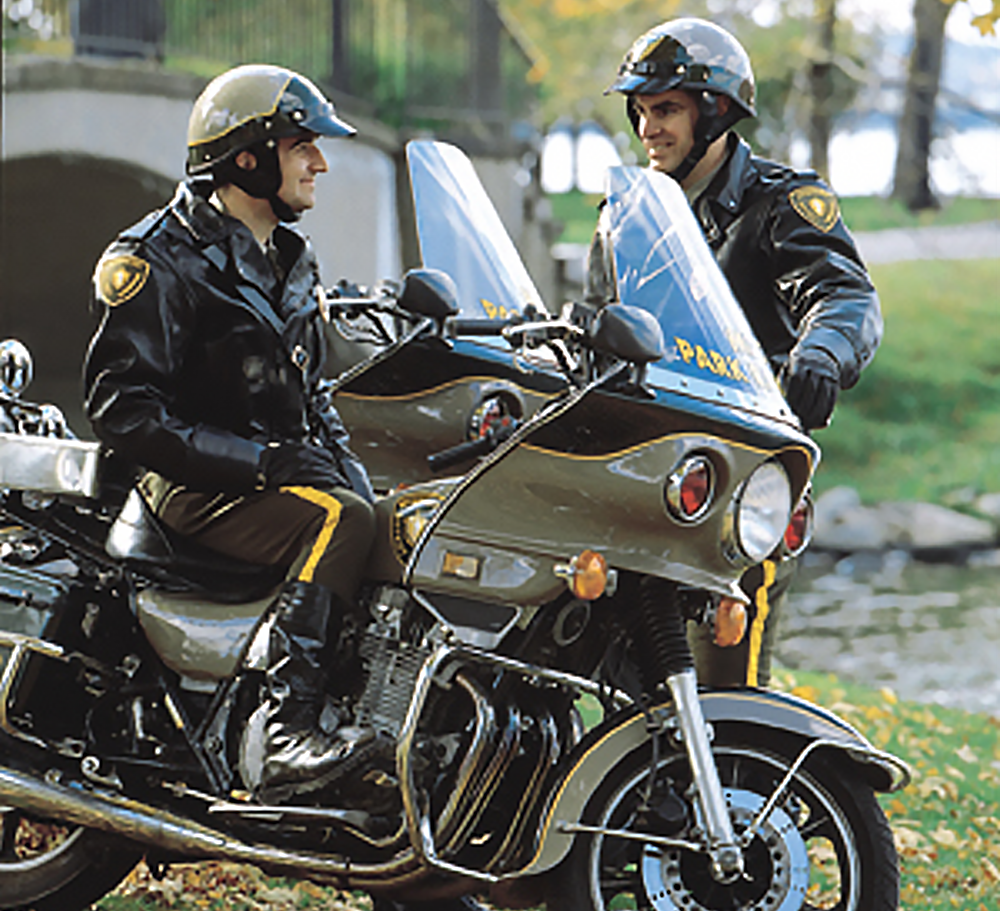
Do Cops Still Wear Leather Jackets: When you picture a motorcycle police officer, a specific image likely comes to mind: the mirrored aviator sunglasses, the high boots, and the imposing black leather jacket. It is a look that commands authority, popularized by decades of Hollywood films ranging from The Wild One to Terminator 2.
But as we move further into 2026, fabric technology has advanced dramatically. Synthetic materials are lighter, more breathable, and often waterproof. With these high-tech options available, do law enforcement agencies still issue heavy cowhide jackets?
The short answer is yes—but usually for specific reasons. While the average patrol officer on foot or in a squad car has largely transitioned to lightweight synthetic bombers or soft-shell jackets, the leather jacket remains a critical piece of equipment for motorcycle units. It is a battle between tradition, intimidation, and the undeniable physics of abrasion resistance.
The origin of the “Motor Cop” look
To understand why Do Cops Still Wear Leather Jackets persists in law enforcement, you have to look back at where the style originated. The leather jacket didn’t start as a fashion statement; it began as a survival tool for World War I aviators who needed protection from the freezing temperatures of open cockpits.
However, the specific “police look” we recognize today traces its roots largely to the California Highway Patrol (CHP). Created in 1929, the CHP needed uniforms that could withstand the elements for officers riding motorcycles all day. According to historical archives from Eastman Leather, while the traditional uniform was khaki with a blue-and-gold trouser stripe, motorcycle officers (or “Motor Police”) adopted Do Cops Still Wear leather jackets for warmth and protection.
This created a visual language that bordered on iconography. The jackets were custom-made for officers, often by approved makers like the Star Glove Co., and always adorned with the famous seven-point badge representing character, integrity, knowledge, judgment, honor, loyalty, and courtesy.
Over time, this look bled into pop culture. When Marlon Brando starred in 1953’s The Wild One, his character—a rebel biker—wore a look that ironically borrowed heavily from law enforcement gear. By the 1970s and 80s, films like Magnum Force used the black Do Cops Still Wear Leather Jackets to turn motorcycle officers into “steely automatons,” cementing the jacket as a symbol of unyielding authority.
Why leather is still the standard for safety
If you ask a motor officer why they Do Cops Still Wear Leather Jackets in 2026, they likely won’t talk about Marlon Brando. They will talk about “road rash.”
The primary reason leather remains in service for motorcycle units is abrasion resistance. Blauer, a long-time manufacturer of police uniforms, notes that while non-leather materials have improved significantly, high-quality leather (specifically cowhide) still provides superior protection when a rider slides across asphalt.
The physics of protection
For a police officer on a motorcycle, a crash is often a question of when, not if. Leather acts as a second skin. In the event of a slide, thick leather absorbs the friction and heat generated by the pavement, preventing it from tearing through to the officer’s skin.
Manufacturers like Reed Sportswear and Taylor’s Leatherwear continue to produce these heavy-duty garments specifically for “tough on-duty tasks.” They aren’t just fashion pieces; they are arguably the most important piece of PPE (Personal Protective Equipment) a motor officer wears, aside from their helmet.
Adaptation to weather
Critics of leather often point out that it is hot in the summer and heavy in the winter. However, modern police jackets are engineered with features to mitigate this:
- Venting systems: Zippered vents on the front, back, and sleeves allow airflow to cool the skin during hot rides.
- Removable liners: Dense, zip-out Thinsulate™ liners allow the jacket to transition from freezing highway patrols to milder spring shifts.
- Fit for riding: Unlike a fashion jacket, duty jackets are cut with slightly longer sleeves to cover the wrists while reaching for handlebars, and a longer back panel to protect the kidney area and spine while seated.
The rise of textiles: A modern challenger
While leather holds the crown for abrasion resistance, it is no longer the only option. In 2026, many departments are adopting “textile” jackets for their versatility.
According to motorcycle gear experts at RevZilla, modern textile jackets—often made from Cordura or similar high-denier nylons—have come a long way. They offer several advantages over traditional leather:
- Weight: Textile is significantly lighter, reducing fatigue for officers wearing gear for 10-hour shifts.
- Weatherproofing: It is much easier to make a nylon jacket waterproof (using Gore-Tex or similar membranes) than a leather one. Leather tends to get heavy and sodden in the rain.
- Maintenance: Textile jackets are generally easier to clean and don’t require the conditioning that leather does to prevent cracking.
Today, you will often see a hybrid approach. Some agencies issue mesh jackets with leather reinforcements in high-impact zones (shoulders and elbows), attempting to offer the best of both worlds.
Patrol vs. Motor: Do Cops Still Wear Leather Jackets
When determining if cops still wear leather, you have to distinguish between the assignments of an officer.
The Patrol Officer:
For the officer driving a squad car (the “beat cop”), the leather jacket is largely a relic. It is bulky, uncomfortable to wear while sitting in a car seat, and expensive to issue to thousands of personnel. Most departments have switched to “Ike-style” synthetic jackets or soft-shell fleeces. These are warm, professional, and budget-friendly.
The Motor Officer:
The motorcycle unit is where leather lives on. Departments like the NYPD and the CHP still utilize leather for these specific units. The risk profile of their job justifies the expense and the weight of the garment. Furthermore, the psychological impact of the Do Cops Still Wear Leather Jackets uniform—the “command presence”—remains a valuable tool for officers who often work alone in traffic enforcement.
Is the leather jacket disappearing?
Despite the nostalgia, the dominance of the leather jacket is slowly waning. Cost is a major factor. A high-quality, union-made leather duty jacket can cost a department between $500 and $800 per unit, whereas a high-performance textile jacket might cost half that amount.
Additionally, animal welfare concerns and the general trend toward “softer” policing looks have led some agencies to move away from the militaristic or aggressive aesthetic associated with black leather.
However, for the men and women who straddle an 800-pound machine to patrol the highways, leather remains the gold standard. It is a piece of equipment that serves a dual purpose: it commands respect from the public, and more importantly, it offers the best chance of walking away from a slide at 60 miles per hour.
So, Do Cops Still Wear Leather Jackets in 2026? If they are on two wheels, the answer is almost certainly yes.










Leave a comment